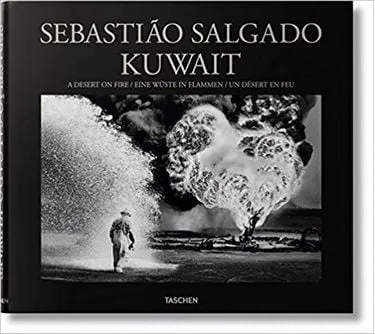
Sebastiаo Salgado. Kuwait. A Desert on Fire
Desert aflame
Sebastiao Salgado documents the torched Kuwaiti oil wells
In January and February 1991, as the United States-led coalition drove Iraqi forces out of
Kuwait
, Saddam Hussein’s troops retaliated with an inferno. At some
700 oil wells
and an unspecified number of oil-filled low-lying areas they ignited
vast, raging fires
, sending billowing black clouds over the region and thousands of tons of nitrous oxide and carbon dioxide into the atmosphere.
As the desperate efforts to contain and extinguish the conflagration progressed,
Sebastiao Salgado
traveled to Kuwait to witness the crisis firsthand. The conditions were excruciating. The
heat was so vicious that Salgado’s smallest lens warped
. A journalist and another photographer were killed when a slick ignited as they crossed it. Sticking close to the firefighters, and with characteristic sensitivity to both human and envrionmental impact, Salgado captured the
terrifying scale of this “huge theater the size of the planet”
: the ravaged landscape; the sweltering temperatures; the air choking on charred sand and soot; the blistered remains of camels; the sand still littered with cluster bombs; and the flames and smoke soaring to the skies, blocking out the sunlight, dwarfing the oil-coated firefighters.
Salgado’s epic pictures first appeared in the
New York Times Magazine
in June 1991 and were subsequently widely published and awarded the
Oskar Barnack Award
, recognizing outstanding images on the relationship between man and the environment.
Kuwait: A Desert on Fire
is the
first monograph of this astonishing series
. Like
Genesis, Exodus,
and
The Children,
it is as much a major document of modern history as an extraordinary body of photographic work.
Text in English, French, and German